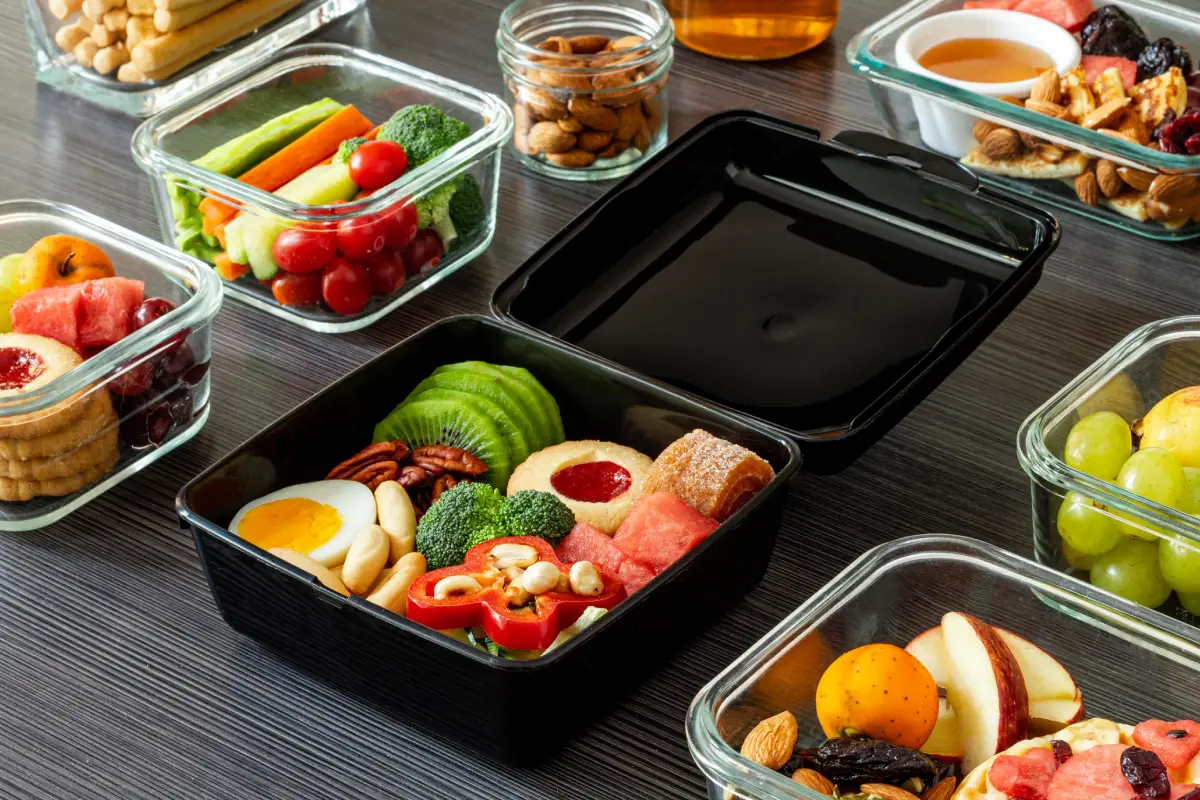
Plastic food packaging is critical for freshness, hygiene, portability, and shelf life. Measuring quality solely by thickness is a mistake. Successful outcomes come from a combination of the right material (especially PP), right-weighting, geometry, and process. Otherwise, product loss, returns, consumer dissatisfaction, and brand damage become likely.
1) Thickness Alone Is Not Quality: Right-Weighting
A thick container is not always more durable; a thin container is not always weak. Material grade, nucleation, rib and corner radius, flange width, lock tolerance, and process drive performance. Right-weighting means meeting target top-load, seal integrity, and drop metrics while avoiding unnecessary weight.
- PP advantage: With low density (~0.90 g/cm³), PP can hit the same mechanical targets at lower weight than PET, reducing material use, cube, and CO₂.
2) Barrier and Shelf Life: Thickness + Material + Design
- Seal integrity and lock: Tolerance, perimeter seal, and lid-body match matter as much as thickness.
- Gas and moisture: PET/APET excels in gas barrier; PP is strong in moisture barrier. Define whether shelf life is gas- or moisture-limited.
- Anti-fog and vent: Correct anti-fog and venting manage condensation in display for PP.
Measure and validate: Seal strength (ASTM F88), leak/tilt, burst; OTR (ASTM D3985), WVTR (ASTM F1249); hot/cold cycles and sensory checks.
3) Mechanical Strength and Logistics: Top-Load and Stack
In warehouse, display stacking, and shipping, the critical metric is top-load compression. Increasing strength comes from ribbing, corner radius, flange width, base doming, and resin choice—not just thickness.
- PP practicality: Hinged PP containers remove assembly, enable fast denesting, and simplify SKU management.
- With proper ribs and flanges, PP delivers high top-load at lower weight.
- TiHi optimization (cases per layer × layers per pallet) increases cube efficiency and cuts shipments and CO₂.
Validate: Top-load (ASTM D642), drop/stack (ASTM D4169), denesting speed, TiHi, case and pallet cube.
4) Food Safety and Migration: Regulations + Testing
“Thin leaches chemicals” is a misconception. Compliance comes from EU 1935/2004, 10/2011 and migration testing. Thickness affects barrier, but safety is the result of the formulation + process + use temperature.
- PP plus: Proper PP grades suit microwave and hot-serve under labeled temperature and time. PP also resists many chemicals.
5) Consumer Perception: Quality, Usability, Communication
- Resealability: PP hinged lids do not get lost; one-handed open-close boosts perceived quality and freshness.
- Clarity: PET leads in showcase clarity; for “sufficient clarity + operational efficiency,” clarified PP is a strong balance.
- Labeling: Build trust with RIC #5 (PP) and clear sorting guidance.
6) Environmental Impact: Lightweighting + Mono-PP + Efficiency
“Thinner equals greener” is not always true; damage and returns worsen net impact. The right path is right-weighting + mono-PP design + logistics efficiency.
- Lightweighting: Less mass with PP at the same performance.
- Mono-PP and RIC #5: Easier sorting and recycling-stream entry.
- PCR-PP: Improves circularity on suitable lines.
- Logistics: High nesting and TiHi mean fewer shipments and lower CO₂.
7) Decision Matrix and Test Protocol
Scenario tips:
- Liquid/semi-fluid + delivery agitation: Two-piece with perimeter seal or reinforced lock.
- Grab-and-go, frequent reseal, microwave: PP hinged with anti-fog, vent, and tuned lock tolerance.
- Showcase clarity + cold display: PET/APET; or clarified PP if clarity is sufficient and operations favor PP.
- Oven/very hot: CPET.
Checklist: Top-load, drop/stack, leak/tilt, seal strength, burst; OTR/WVTR; microwave/hot and hinge cycles; denesting speed; TiHi and cube; migration/sensory and Declaration of Conformity.
Conclusion: Choose Smart Design, Not Thinness
Aim for maximum performance with minimal resources—without compromising safety or experience. Achieve it with right-weighting, PP-focused design, and validation tests. PP balances performance, cost, and sustainability via low density, hot-use compatibility, mono-material recycling, and hinge technology. Packmaster delivers end-to-end PP-based solutions from design to testing and logistics optimization.