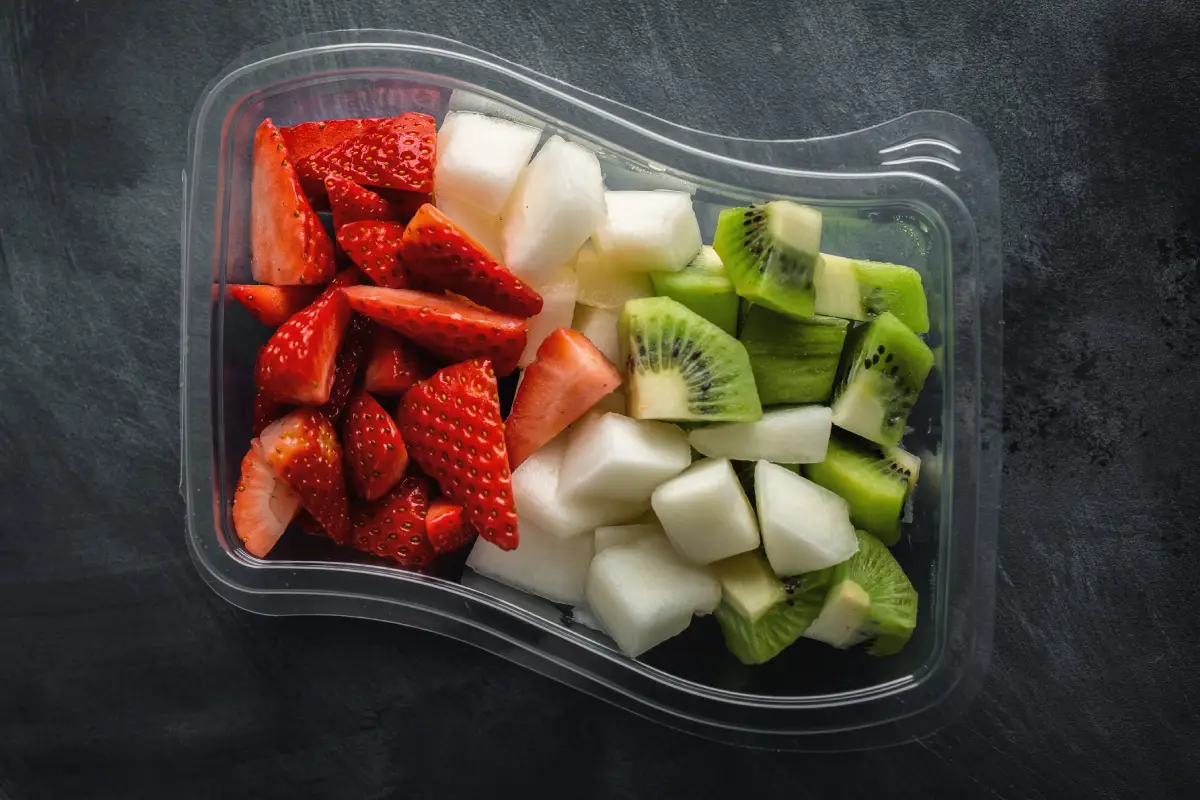
Hinged designs, where the lid and body are a single piece, excel in grab-and-go and quick-service scenarios.
- Ease of Use: The lid cannot get lost; one-handed open–close, resealing between portions → perception of freshness and higher customer satisfaction.
- Production Efficiency: Single SKU, no assembly; easy denesting; increased OEE, reduced labor and errors.
- Logistical Advantage: High nesting and good TiHi enable case/pallet efficiency; low cube, fewer shipments, lower cost/CO₂.
- Seal Integrity & Display: Robust lock tolerance reduces spill risk; anti-fog/vent options keep displays clear.
The PP Difference: PP hinged containers offer microwave/hot-serve compatibility (with suitable grade), lightweighting via low density, and easier entry into recycling streams through mono-PP design. PCR-PP options can be considered for suitable products.
Note: Hinged containers are generally not fully hermetic. For very liquid contents or high spill risk, prefer designs with tighter lid tolerance, a perimeter seal band, or a tamper-evident hinge.
Which One for Which Scenario?
Choose Hinged (PP), if:
- Grab-and-go salads, sandwiches, bakery; hot serve/microwave (with suitable PP grade)
- Fast lines, low labor, need for a single SKU
- You aim to reduce warehouse/transport cube and CO₂
- Resealability and transport security are critical for the customer
Choose Two-Piece (Body + Lid/Film), if:
- Hermetic sealing with perimeter seal/MAP and extended shelf life are priorities
- Very liquid/oily products face tilting/agitation during delivery
- Specific bowl/container forms are desired for display stacking
Make an Informed Decision: Short Test Protocol
- Leak / tilt test: Liquid leakage and tilt resistance
- Drop / stack: Shipping and shelf stacking; top load strength
- Microwave / hot cycle: Heat profile per PP grade and label pictograms
- Hinge cycle: Open–close cycles and lock performance
- Anti-fog / vent: Observe condensation under display lighting
- Nesting / TiHi: Case/pallet cube and transport data
Sustainability: Practical Circularity with PP
- Mono-PP design, RIC #5, and label/adhesive/pigment choices that aid sorting
- Lightweighting from low density → less material, less transport energy
- PCR-PP integration on suitable lines; transparent DoC and accredited test reports
Conclusion
The best packaging is the one most suitable for your scenario. PP hinged solutions generally deliver speed, ergonomics, cost, and logistics benefits, while two-piece + perimeter seal excels where hermeticity and shelf life dominate. With PP-focused design, lightweighting, anti-fog/vent, and tamper-evident options, Packmaster helps accelerate your line and elevate customer experience. Let’s choose the optimal solution together with samples and a clear test protocol.